
C Curiously Recurring Template Pattern
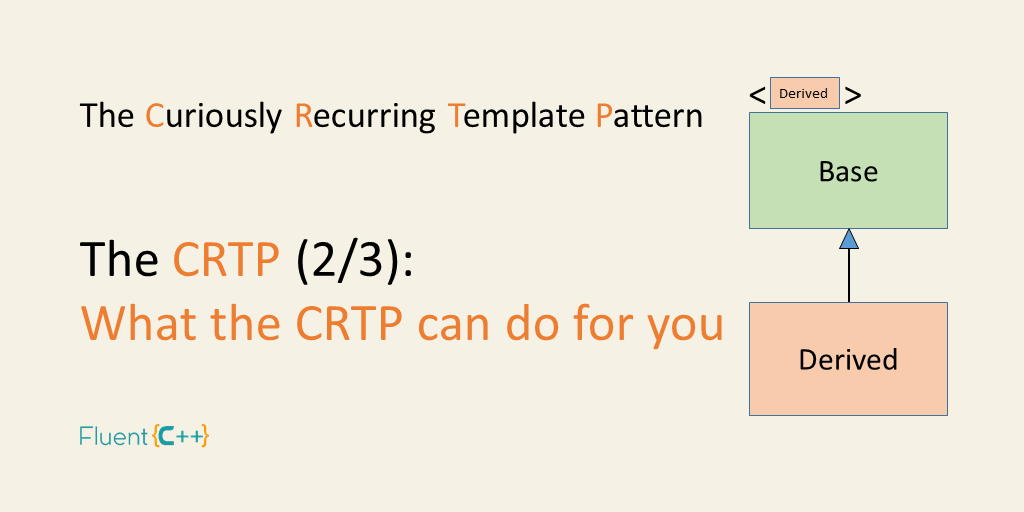
C Curiously Recurring Template Pattern - Very specifically, the crtp can be used instead of a base class with virtual functions to implement the template method pattern without virtual function call overhead. # curiously recurring template pattern (crtp) a pattern in which a class inherits from a class template with itself as one of its template parameters. Some curiosity in the form of the curiously recurring template pattern.
In the previous lesson, we learned how to implement dynamic polymorphism. Very specifically, the crtp can be used instead of a base class with virtual functions to implement the template method pattern without virtual function call overhead. The derive class is representing an interface used by the base class. Crtp is a design pattern in c++ in which a class x derives from a.
Related Topics
Learn about the curiously recurring template pattern commonly known as crtp. Some curiosity in the form of the curiously recurring template pattern. The pattern discussed in this lesson has a rather curious name: The curiously recurring template pattern is an idiom in which a class x derives from a class template y, taking a template parameter z, where y is instantiated with z = x. The crtp is an idiom in c++ in which a class let’s call it x derives from a class template instantiation. With the help of the pattern you access the derived class' public.
C++ Curiously Recurring Template Pattern
Crtp is a design pattern in c++ in which a class x derives from a. Usage of vptr and vtable can be avoided altogether through curiously recurring template pattern (crtp). Crtp is usually used to.
The Curiously Recurring Template Pattern (CRTP) Fluent C++
How can i define a class which is inherited from another class, which gets the currently defined class as template parameter? The “curiously recurring template pattern” (crtp) is a very elegant way to implement something.
C++ Curiously Recurring Template Pattern
Crtp is usually used to provide static. But as we have seen, we have. The pattern discussed in this lesson has a rather curious name: Learn about the curiously recurring template pattern commonly known as.
C++ Curiously Recurring Template Pattern
Crtp is usually used to provide static. The derive class is representing an interface used by the base class. Curiously recurring template pattern (crtp) in c++ is definitely a powerful technique & static alternative to.
Applying Curiously Recurring Template Pattern in C++
Learn to implement the crtp and unlock its potential to simplify and optimize c++ code. But at the same time, learning it may seem a. How can i define a class which is inherited from.
C++ Curiously Recurring Template Pattern
Just to make it clear: Crtp is a design pattern in c++ in which a class x derives from a. But as we have seen, we have. The curiously recurring template pattern is an idiom.
C++ Curiously Recurring Template Pattern
It turns out that using templates, c++ provides an alternative way to implement polymorphism without the extra costs. # curiously recurring template pattern (crtp) a pattern in which a class inherits from a class template.
But as we have seen, we have. In the previous lesson, we learned how to implement dynamic polymorphism. The pattern discussed in this lesson has a rather curious name: The curiously recurring template pattern is an idiom in which a class x derives from a class template y, taking a template parameter z, where y is instantiated with z = x. # curiously recurring template pattern (crtp) a pattern in which a class inherits from a class template with itself as one of its template parameters.
In the previous lesson, we learned how to implement dynamic polymorphism. Learn about the curiously recurring template pattern commonly known as crtp. Usage of vptr and vtable can be avoided altogether through curiously recurring template pattern (crtp). # curiously recurring template pattern (crtp) a pattern in which a class inherits from a class template with itself as one of its template parameters.
How Can I Define A Class Which Is Inherited From Another Class, Which Gets The Currently Defined Class As Template Parameter?
In the previous lesson, we learned how to implement dynamic polymorphism. # curiously recurring template pattern (crtp) a pattern in which a class inherits from a class template with itself as one of its template parameters. Crtp is usually used to provide static. Curiously recurring template pattern (crtp) in c++ is definitely a powerful technique & static alternative to virtual functions.
Very Specifically, The Crtp Can Be Used Instead Of A Base Class With Virtual Functions To Implement The Template Method Pattern Without Virtual Function Call Overhead.
The curiously recurring template pattern is an interesting technique at least to know and sometimes to use. The pattern discussed in this lesson has a rather curious name: The curiously recurring template pattern is an idiom in which a class x derives from a class template y, taking a template parameter z, where y is instantiated with z = x. Just to make it clear:
Learn To Implement The Crtp And Unlock Its Potential To Simplify And Optimize C++ Code.
But at the same time, learning it may seem a. The crtp is an idiom in c++ in which a class let’s call it x derives from a class template instantiation. But as we have seen, we have. Some curiosity in the form of the curiously recurring template pattern.
The “Curiously Recurring Template Pattern” (Crtp) Is A Very Elegant Way To Implement Something Called “Static Polymorphism.” By Using “Static Polymorphism,” The.
With the help of the pattern you access the derived class' public. Usage of vptr and vtable can be avoided altogether through curiously recurring template pattern (crtp). Crtp is a design pattern in c++ in which a class x derives from a. The derive class is representing an interface used by the base class.
Usage of vptr and vtable can be avoided altogether through curiously recurring template pattern (crtp). # curiously recurring template pattern (crtp) a pattern in which a class inherits from a class template with itself as one of its template parameters. Very specifically, the crtp can be used instead of a base class with virtual functions to implement the template method pattern without virtual function call overhead. Some curiosity in the form of the curiously recurring template pattern. The pattern discussed in this lesson has a rather curious name: