
Tracheostomy Suctioning Nursing Skill Template
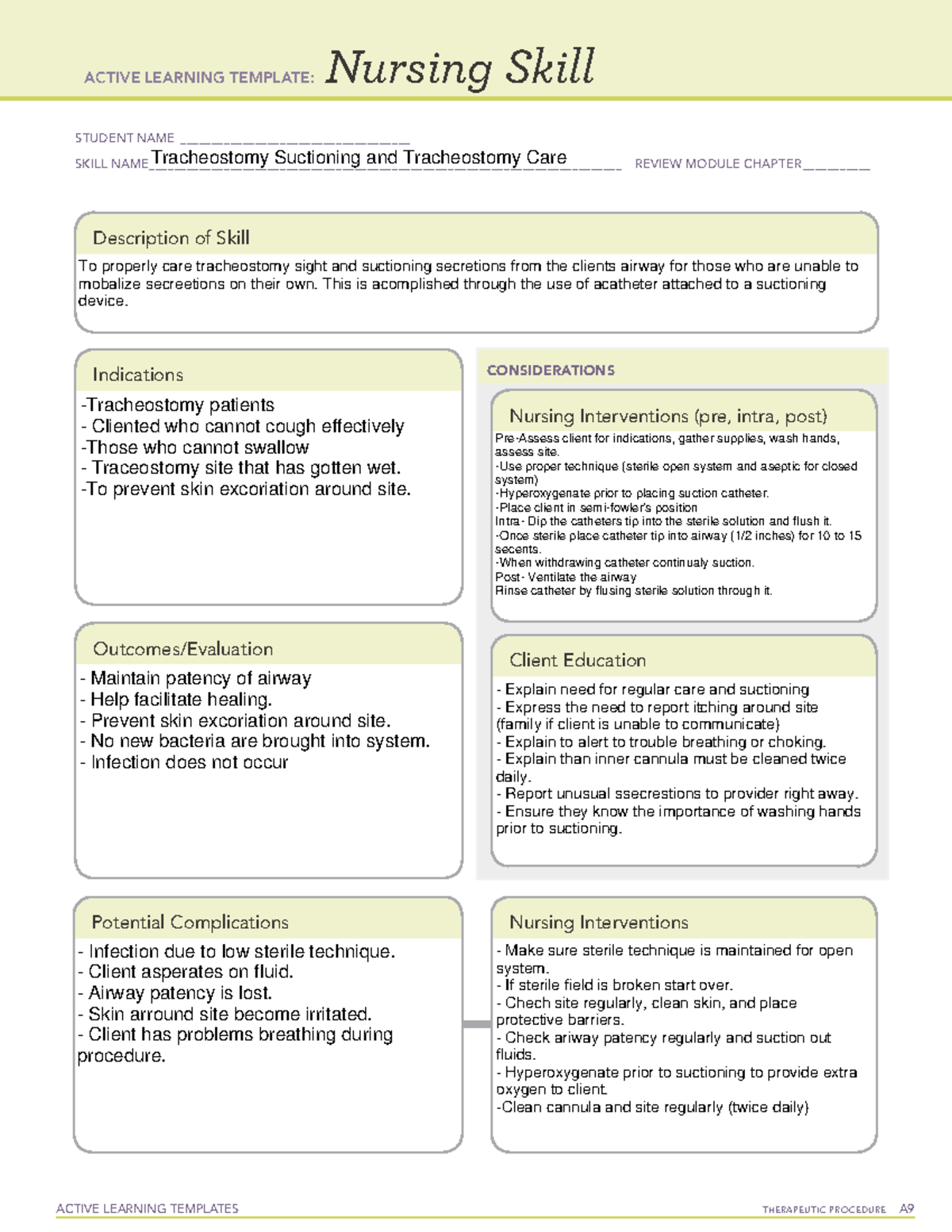
Tracheostomy Suctioning Nursing Skill Template - Open suctioning requires disconnection of the patient from the oxygen source, whereas closed suctioning uses an inline suctioning catheter that does not require disconnection. Demonstrate it and teach it back to you. Pull cannula out in a downward motion.
Intact without any excess drainage. Be sure to withdraw the entire catheter to. Teach pt proper technique for cleaning tracheostomy and surrounding skin. Safely perform nasal, oral, pharyngeal, and tracheostomy suctioning.
Related Topics
Atinursi ng ski ll tracheostomysucti oni ng descri pti onofski ll: Open suctioning requires disconnection of the patient from the oxygen source, whereas closed suctioning uses an inline suctioning catheter that does not require disconnection. Connect the client to the pulse oximeter. Tracheostomy suction is to clear airways of secretions that client cant clear on their own. *inserts suction catheter into tracheostomy to correct targeted suction depth , where the targeted color meets the blue or black entry point of the closed suction catheter Adapt procedure to reflect variations across the life span.
Tracheostomy Suctioning Nursing Skill Template
Open suctioning requires disconnection of the patient from the oxygen source, whereas closed suctioning uses an inline suctioning catheter that does not require disconnection. Intact without any excess drainage. Tracheostomy suctioning open system confirm the.
Active Learning Template Nursing Skill Trach care STUDENT NAME
Pull cannula out in a downward motion. Tracheostomy care cleaning around the stoma and inside the trach as well as removing and cleaning the inner cannula (or disposing of it if the inner cannula is.
Tracheostomy Suctioning Nursing Skill Template
Tracheostomy suctioning open system confirm the length of the tracheostomy tube. Safely perform nasal, oral, pharyngeal, and tracheostomy suctioning. *inserts suction catheter into tracheostomy to correct targeted suction depth , where the targeted color meets.
Tracheostomy Suctioning Nursing Skill Template prntbl
Teach pt proper technique for cleaning tracheostomy and surrounding skin. Tracheostomy suctioning open system confirm the length of the tracheostomy tube. Adapt procedure to reflect variations across the life span. Reassure the patient that they.
Active Learning Template Tracheostomy Suctioning and Tracheostomy Care
Teach pt proper technique for cleaning tracheostomy and surrounding skin. Tracheostomy suctioning open system confirm the length of the tracheostomy tube. Open suctioning requires disconnection of the patient from the oxygen source, whereas closed suctioning.
Tracheostomy Suctioning Nursing Skill Template
Open suctioning requires disconnection of the patient from the oxygen source, whereas closed suctioning uses an inline suctioning catheter that does not require disconnection. Safely perform nasal, oral, pharyngeal, and tracheostomy suctioning. Adapt procedure to.
Tracheostomy Suctioning Nursing Skill Template Printable Word Searches
Teach pt to only apply suction when withdrawing catheter, not while inserting. Some inner cannulae will “click” on, some twist on/off. Open suctioning requires disconnection of the patient from the oxygen source, whereas closed suctioning.
Hyperoxygenate according to hosptial policy. Tracheostomy care cleaning around the stoma and inside the trach as well as removing and cleaning the inner cannula (or disposing of it if the inner cannula is disposable, then putting a. Tracheostomy suctioning open system confirm the length of the tracheostomy tube. Pull cannula out in a downward motion. *inserts suction catheter into tracheostomy to correct targeted suction depth , where the targeted color meets the blue or black entry point of the closed suction catheter
Safely perform nasal, oral, pharyngeal, and tracheostomy suctioning. Open suctioning requires disconnection of the patient from the oxygen source, whereas closed suctioning uses an inline suctioning catheter that does not require disconnection. Hyperoxygenate according to hosptial policy. Demonstrate it and teach it back to you.
Open Suctioning Requires Disconnection Of The Patient From The Oxygen Source, Whereas Closed Suctioning Uses An Inline Suctioning Catheter That Does Not Require.
Some inner cannulae will “click” on, some twist on/off. Use written communication when needed. Demonstrate it and teach it back to you. Intact without any excess drainage.
Teach Pt To Only Apply Suction When Withdrawing Catheter, Not While Inserting.
Hyperoxygenate according to hosptial policy. Connect the client to the pulse oximeter. Safely perform nasal, oral, pharyngeal, and tracheostomy suctioning. As ur gi c a l l yc r e a t es t omama dei nt het r a c he a( uppe ra i r wa yr e ma i nsi nt a c t ) ,j us tbe l o wt.
Reassure The Patient That They Are Okay.
Tracheostomy suctioning open system confirm the length of the tracheostomy tube. Open suctioning requires disconnection of the patient from the oxygen source, whereas closed suctioning uses an inline suctioning catheter that does not require disconnection. Adapt procedure to reflect variations across the life span. Be sure to withdraw the entire catheter to.
Pull Cannula Out In A Downward Motion.
Do not touch the inner cannula; Tracheostomy suction is to clear airways of secretions that client cant clear on their own. *inserts suction catheter into tracheostomy to correct targeted suction depth , where the targeted color meets the blue or black entry point of the closed suction catheter Open suctioning requires disconnection of the patient from the oxygen source, whereas closed suctioning uses an inline suctioning catheter that does not require disconnection.
Open suctioning requires disconnection of the patient from the oxygen source, whereas closed suctioning uses an inline suctioning catheter that does not require disconnection. Pull cannula out in a downward motion. Teach pt to only apply suction when withdrawing catheter, not while inserting. Demonstrate it and teach it back to you. As ur gi c a l l yc r e a t es t omama dei nt het r a c he a( uppe ra i r wa yr e ma i nsi nt a c t ) ,j us tbe l o wt.